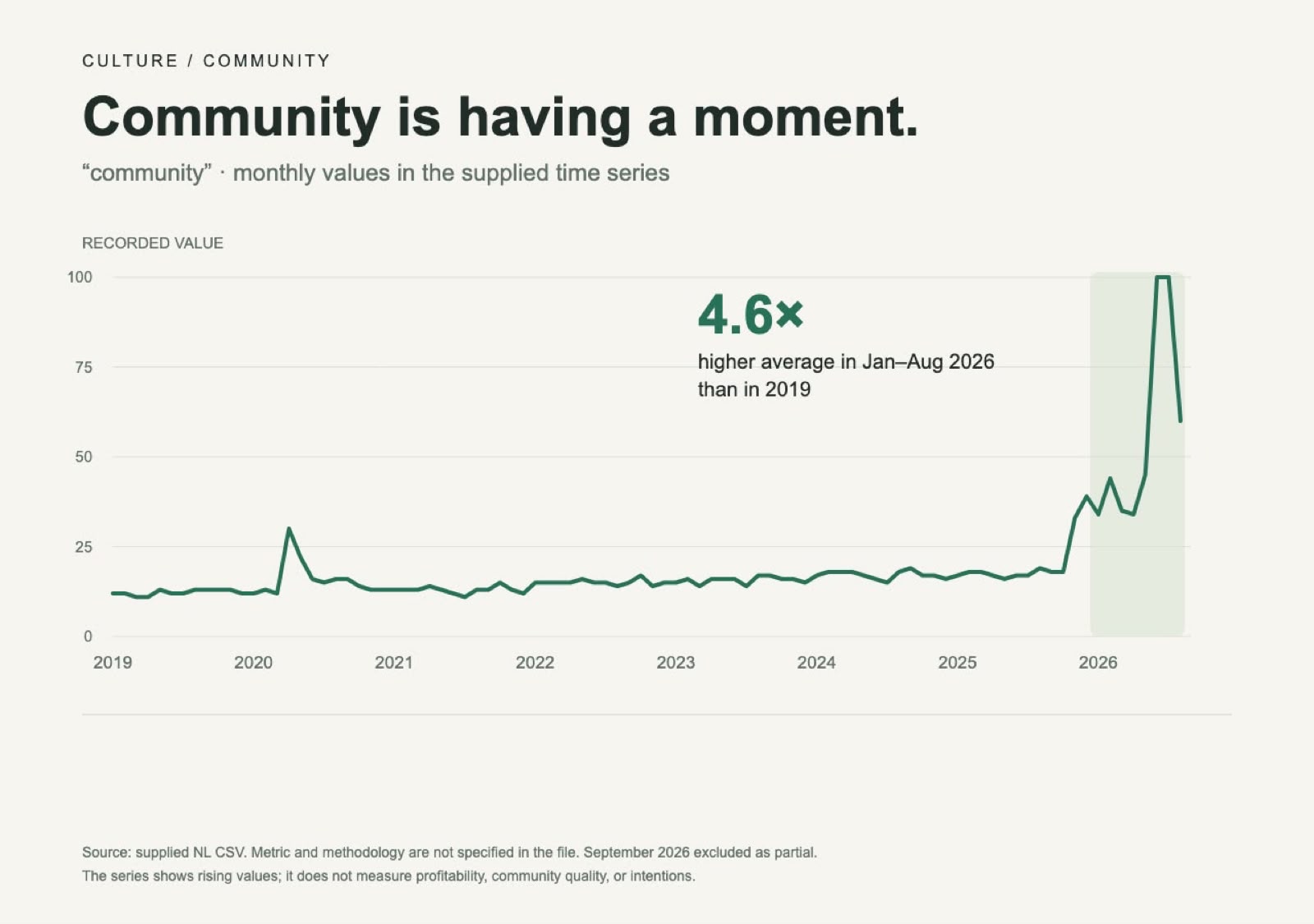
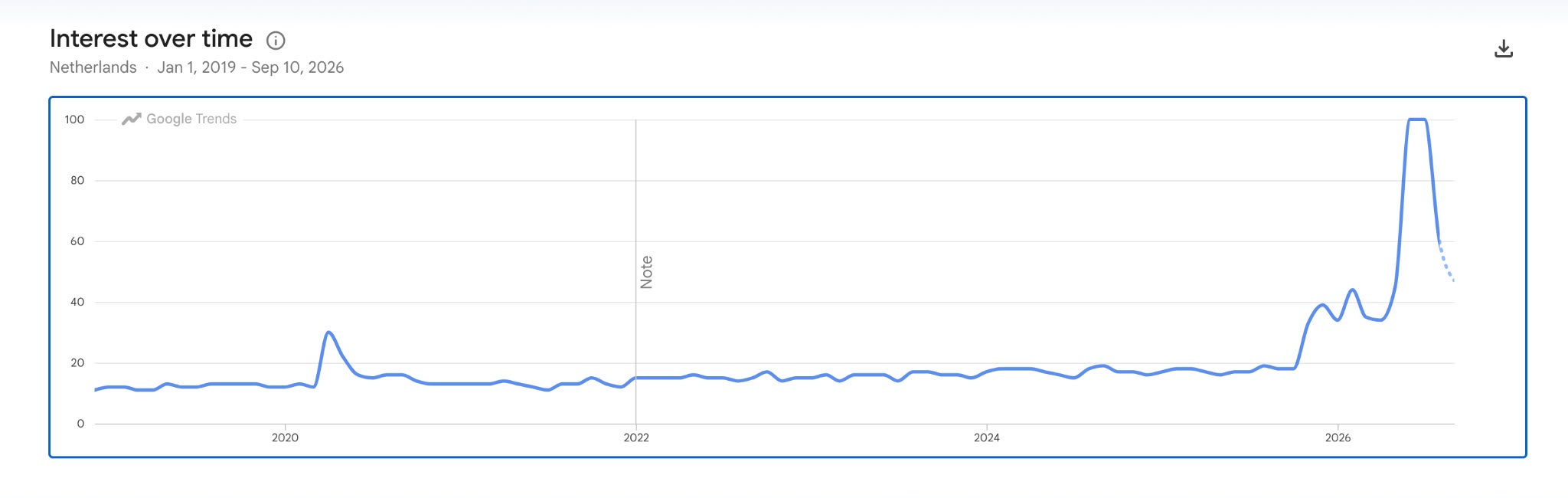
In today’s marketing landscape, we see a heavy spike in “community” searches on Google trends in the Netherlands.
Another issue is that a lot of companies are mistaking their audience for “community”. These are not interchangeable terms. Merriam-Webster (n.d.) makes a clear distinction between the two. Where audience relates to a group of listeners or spectators, whilst a community is an interacting population if various kinds of individuals in a common location.
Influencers and brands refer to their audiences as “communities” but they’re not alone. Cafés, newsletters, fashion labels and platforms all use the language of belonging. However, sharing an interest in the same person, product or company does not automatically create a community. A genuine community forms when individuals shift their focus toward one another. Recognizing this difference is becoming more crucial than ever. If a brand or influencer fails to foster actual interaction, they are cultivating a passive audience rather than a true community. While that distinction isn't inherently negative, it begs the question: why are so many brands now adopting the language of belonging?
There is a good reason companies want to call what they have a community. Community creates loyalty, trust, word of mouth, cultural relevance and repeat customers. In marketing language, these are very valuable things.
Furthermore, this is happening at a moment when people are genuinely craving connection. The World Health Organization (2025) estimates that around 1 in 6 people globally experience loneliness (~15.8% of the global population). So the desire for belonging is real and dire for survival. What feels uncomfortable is how quickly that need has been turned into a marketing opportunity.
Community-washing:
Sometimes, what we call community is simply customer acquisition with high production value.
Kriticos’ personal experience: "My journey building The Book Club has shown me that “community” cannot be forced simply by slapping a label on a group of people. Authentic communion emerges from intentional choices. For example, we break traditional book club barriers to ensure that everyone feels welcome."
"These rules change everything. More people are likely to show up to the event, less people feel ostracised and much like my days in university, it created a sense of togetherness to know that nobody did the homework and that there are no social hierarchies."
"Using quotes and conversation prompts, we make “ice-breaking” less awkward, but also encourage conversation among everyone involved. We arrange the spaces to encourage people to face each other and/or sit next to each other. Whether you came alone, or with friends, you will feel included in the collective. The central focus with the sessions has always been: “How will this bring people together?”
"With the idea of bringing people together at the center of all our activities, fostering a community becomes a by-product of events, rather than a marketing KPI."
"The organizer isn’t the focal point: The lines between audience and community are frequently blurred. If all ties depend on one central figure, you have built a devout audience rather than authentic human connections. Consider what happens if the host steps out of the room: do the participants continue engaging in meaningful discussion, or does the dialogue grind to a halt? At The Book Club, my purpose isn't to be the focal point of the space. In fact, my objective is quite the reverse: to build a framework robust enough that dialogue thrives without my involvement. As a host, the main goal is to get people to talk amongst themselves and completely forget about me. That’s the sweet spot!"
Perhaps the simplest method to evaluate if an initiative truly prioritizes connection is by evaluating these key questions:


